
 Language


More Language
Language One-stop comprehensive solution provider
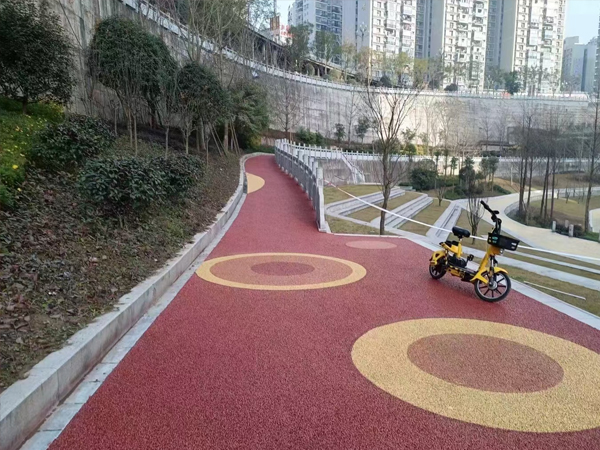
Porous permeable pavement allows for rapid water infiltration, preventing water accumulation and mud splashing on rainy days; it is fully colored, sun-resistant, and faderesistant, while being anti-slip, wear-resistant, and freeze-resistant without cracking; it keeps the ground cooler in summer, provides good noise reduction, and is easy to. It is widely used in courtyards, park walkways, residential community paths, and fitness greenways, making it suitable for both pedestrians and private vehicles, while being ecologically beautiful durable.
 |  |  |
 |  |  |
Three main materials for permeable pavement: permeable enhancer, iron oxide color powder, and colored surface sealer. Permeable pavement is entirely different from stamped concrete systems—uniformly mixed and colored, relying on aggregate pores for water permeability. Each of the three materials plays a distinct role. Below, we explain in detail the core functions, standard dosages, complete application procedures, and key construction tips for each component.
1. Permeable Pavement Enhancer (Permeable Binder / Gel Enhancer)
Core Function (the most critical additive in permeable concrete):
1. Solves common problems in permeable pavements: balancing strength and permeability. Ordinary permeable concrete relies solely on cement to bind aggregates, resulting in point contact between stones that easily leads to particle loss, sanding, and cracking. The enhancer contains high-molecular polymers that form bonding bridges between aggregates, firmly encapsulating the surface layer of crushed stone. This achieves compressive strengths of C25–C30 while maintaining 15%–25% interconnected voids for water drainage, preventing water accumulation during rain.
2. Significantly improves freeze-thaw resistance, reduces shrinkage cracking, and suppresses alkali bloom. It greatly enhances concrete’s cold resistance, ensuring no particle loss even under repeated freeze-thaw cycles in northern winters. It minimizes fine cracks caused by cement hydration shrinkage and prevents efflorescence whitening, effectively doubling outdoor service life.
3. Improves workability and extends initial setting time. After mixing, the cement paste does not flow or bleed, avoiding clogging of permeable pores, making large-area paving easier and more efficient.
4. Enhances wear and abrasion resistance. For walkways and parking lots subjected to long-term wheel traffic and rain erosion, the surface remains durable with minimal wear or flaking.
2. Application Method and Standard Proportions:
1. Typical dosage – Powdered enhancer: 10 kg per cubic meter of permeable concrete.
2. Mixing sequence (must follow order to ensure uniform color and strength):
Aggregate (clean 3–5 mm crushed stone) → 42.5 Portland cement → permeable enhancer → iron oxide color powder. Dry mix for 30 seconds until evenly blended. Add water in 2–3 stages and mix thoroughly for 2–3 minutes.
Acceptable consistency: each stone grain should be uniformly coated with a thin layer of cement paste; when squeezed by hand, it forms a solid ball that holds together without crumbling or dripping excess slurry. (Too thick slurry blocks pores; too thin causes particle loss.)
3. Paving and Finishing Tips:
①. Pave only after the subbase has been compacted and stabilized. Typical thickness: 5 cm for pedestrian areas, 8–10 cm for parking lots.
②. Use low-frequency vibratory plate to lightly vibrate for 3–5 seconds for leveling. **Never use high-power vibration** (it forces cement paste into the base, blocking permeable pores).
③. Lightly finish before initial set, cut expansion joints every 3–5 meters to prevent thermal cracking due to temperature changes.
④. Immediately cover with geotextile or plastic film for moisture retention curing: 7 days at normal temperatures, 14 days in cold northern regions. Keep surface moist throughout curing period; no foot traffic or vehicle access allowed during this time.
2. Iron Oxide Color Powder (Inorganic Weather-Resistant Pigment, Internal Coloring Agent for Permeable Pavement)
Core Functions:
1. Permanent full-body coloring: Mixed directly into the concrete during batching, coloring the entire aggregate matrix rather than just surface painting. Resists fading, yellowing, or discoloration from sun exposure and rain, suitable for outdoor use for over 10 years. Organic pigments degrade quickly and are unsuitable for outdoor permeable applications.
2. Stable color and excellent acid-base resistance: Compatible with the alkaline environment of cement, unaffected by chemical corrosion or color change. Can freely blend common landscape colors such as red, yellow, black, brown, and green.
3. Low cost and excellent dispersion: Fine powder ensures smooth mixing without clumping or color variation, ideal for large-scale batch mixing.
Standard Dosage Guidelines:
①. Recommended addition ratio (based on cement weight):
- Light colors (light yellow, light gray): 3%–4%
- Standard colors (brick red, earth yellow): 4%–6%
- Dark colors (carbon black, dark brown): 6%–8% (black requires only 1%–3% for deep color)
> Excessive dosage may reduce overall concrete strength; do not exceed 8%.
②. Correct mixing procedure: Mix color powder first with cement and enhancer as dry powders until uniform, then add aggregate for dry blending, finally introduce water.
Never add directly into water during mixing—this often results in uneven color distribution and patchy appearance. ③. Practical Tips
- For soft, vintage tones: Use gray cement with a small amount of iron oxide;
- For vibrant colors: Prefer white cement as the base for color adjustment;
- Common color combinations: Iron red = pathway brick red, iron yellow = antique beige, iron black = dark gray permeable parking lot.
III. Colored Surface Coating (Acrylic Sealer/Permeable Pavement Topcoat)
The final step in completing permeable pavement.
Core Functions
1. Color Locking and Stabilization – Prevents whitening and fading
Penetrates 2–3 mm into the surface pores, sealing cement capillaries to block UV rays, rainwater, and acid rain erosion. Effectively locks in iron oxide pigments, completely resolving issues such as alkali bloom and surface whitening.
2. Surface Reinforcement – Prevents aggregate loss
Bonds loose surface aggregates, significantly improving wear resistance so that particles won’t easily break off under foot traffic or vehicle movement. Oil stains and mud cannot penetrate—routine cleaning with water is sufficient.
3. Color Uniformity and Visual Enhancement
Eliminates color variation across the surface, offering either a matte, warm, antique finish or a glossy, clean appearance. Can also be applied a second time to deepen the color further.
4. Maintains Permeability – Forms a breathable film that doesn't block internal voids, allowing the ground to continue draining water effectively.
III. Complete Application Process
1. Pre-Construction Requirements (Critical)
Ensure permeable pavement has cured for at least 7 days, with the surface fully dry and moisture content below 8%. Remove all dust and debris; no standing water or dampness allowed. Do not apply during rain, when humidity exceeds 85%, or when temperature drops below 5°C.
2. Quantity and Application Layers
- Total usage: 0.35–0.4 kg/m², applied in two coats.
First coat: Thin application for penetration. Allow to dry completely (60–90 minutes), then spray the second coat vertically to achieve an even, full film.
3. Application Method
Use high-pressure airless sprayer first (ensures more uniform coverage in porous areas). For small areas, use a long-haired roller in horizontal and vertical strokes.
4. Curing and Traffic Opening Time
- 4 hours after spraying: Surface dry to touch—no walking allowed
- 24 hours: Fully dry—pedestrian traffic permitted
- 7 days: Full curing complete—vehicle traffic allowed
IV. Complete Construction Sequence for Permeable Pavement
Compact subsoil → Lay permeable concrete (cement + aggregates + enhancer + iron oxide pigment) → Level and light vibrate → Cut expansion joints → Cover with film and cure for 7–14 days → Allow surface to dry completely → Apply two coats of colored surface coating → Final curing and open to traffic
V. Key Differences Among the Three Core Materials
1. Permeable Enhancer: Binds the aggregate matrix, ensuring strength and permeability—added during mixing.
2. Iron Oxide Pigment: Provides permanent internal coloring—added during mixing.
3. Colored Surface Coating: Applied post-construction to protect the surface, lock color, and prevent particle loss—applied after curing as the finishing step.